
The Stupid Fear of AI : A 5 Whys Autopsy on the Death of Industrial Identity
Using the 5 Whys framework, this article reveals that AI project failures aren't about technology—they're about identity death. As the industrial era's process-driven identity crumbles, the path forward is embracing collaborative, relational work.

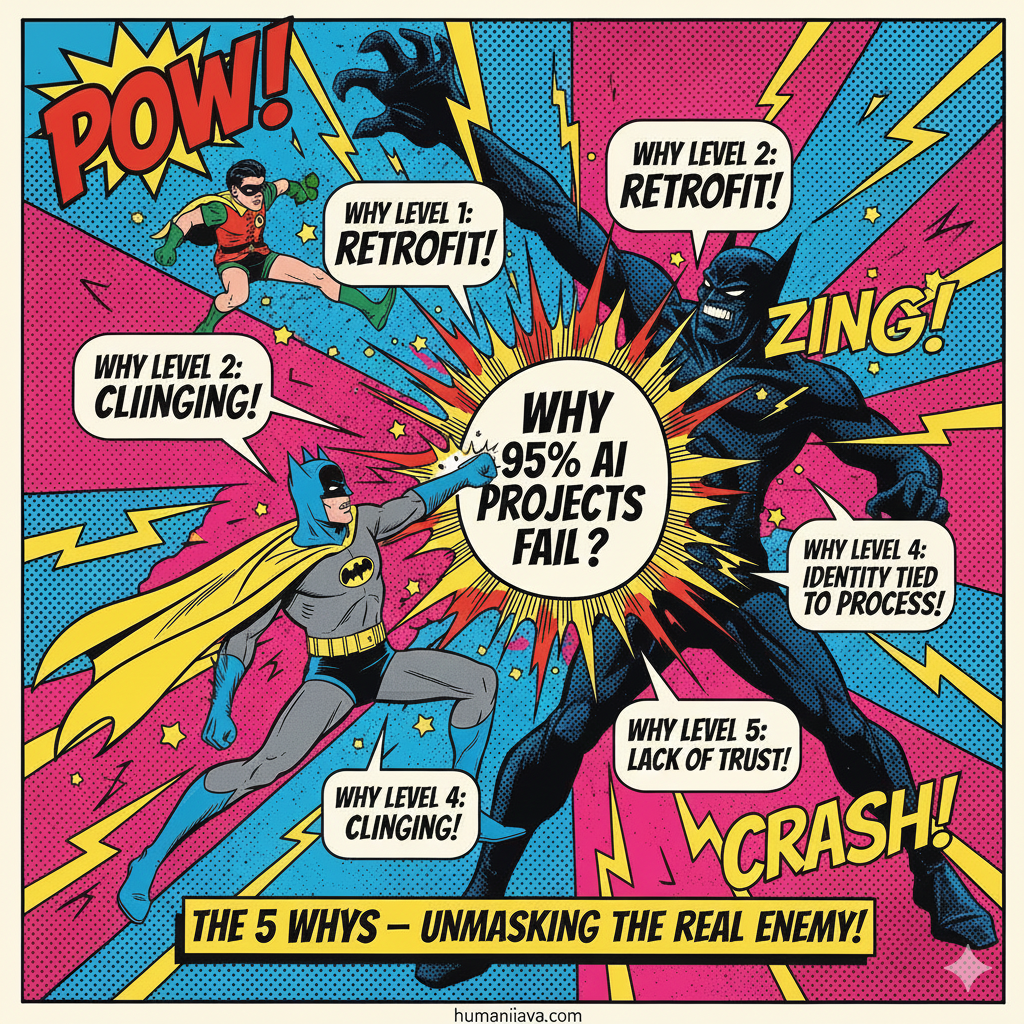
Introduction: This is a response piece... BUT it's also 'the pivot' in this age of corporate transformation. Written in response to a recent article that claimed 95% of internal AI projects fail.
I've seen this pattern before; as a long time UX designer and product builder a new technology comes along and 'the table flipping begins'. Using the '5 Whys' approach we can get to the heart of the issue.
Plot spoiler: It's not about AI. It's about identity.
Fear is the reason Good people lose their way
Welcome to 2026. Expect a lot of high failure rate articles about AI (in-the-workplace) with 'we told you so' commentary. This current state of business isn't just about failed AI projects; it's a funeral for a way of being. A mode of business that some of us have already outlived.
Articles written with a tone of quiet sabotage, and reactions that lack, the spark of AI collaboration. Instead of writing a reaction article to that state of mind... let's use a UX framework that really helps to identify change and instead...
Let's do a 5 Whys exploration
What's actually dying here; and why some people are terrified?
What is that lifeline and landmark that can be pointed towards? What's preventing people and businesses, from stepping into the next epoch with AI as a creative partner?
Regardless of whether the world is ready, there are people (and businesses) who are already living in the future working with AI/LLMs. Some are vibe-coding entrepreneurs, others are co-creating art-pop. In every situation there's a collaboration happening between those looking at the screens, and the AI compute within their LLM platforms.
Why level 1 - Why do 95% of internal AI projects fail?
Because: They're trying to retrofit a V12 engine into a Ford Fiesta.
A core theme across many very clickable articles online. Articles claiming they want the magic (of AI) without the transformation. Organizations want 'double-digit cost reductions' while keeping their 'convoluted & political mess' of business processes intact. Treating AI like a faster horse instead of a completely different mode of transportation.
Trying to shove this tech into a 30-year-old business structure means upending the risk calculus that has kept these organizations afloat for decades. And with that, they're stuck in the 'Instruction Manual' phase. Reading documentation, hiring consultants; and canceling initiative because of scope, loss, and an inability to improve shareholder value.
A lot of articles cover this topic, but few really get to the heart of it. A miserable reality, where organizations are 'emotional, illogical, and without cohesion'.
Analysis: Lets go a level deeper using this as our question in the next layer of why.
Why level 2 - Why are they trying to retrofit instead of reimagine?
Because: The current structures are built on fiefdoms and gatekeeping.
High performing teams / people in these structures have spent 30+ years mastering a specific way of doing things. Building their entire professional identity around knowing the perfect 4-step approval process, understanding the legacy platform, and being the gatekeeper of institutional knowledge.
'Yesterday's expertise is today's ball and chain'. Admitting those skills are now a liability is a TOUGH leap of thought. Up until now, career security has been tied to process mastery, not alignment, vibes and resonance. If AI makes their expertise obsolete, what's left?
That's not a technical problem. That's an existential crisis.
Every team leader has pushed innovation to the edges of their workspace. Every employee's success metrics are predicted on data that supports their position within the organization and leadership stories; all of it requiring low-risk consistency that AI threatens.
Analysis: Lets go a level deeper on business structure in the next layer of why.
Why level 3 - Why are they clinging to those fiefdoms?
Because: Every employee & line-of-businesses value is tied to process mastery, not outcome resonance.
The 'quiet sabotage' of most AI projects isn't in malice. The failure usually stems from a desperate attempt to stay relevant. From a fear that AI technology will remove that sense of personal value, and that reason to come to work everyday. Every business has a 'Reason To Believe' that the work matters. For internal staff, and teams, if that entire sense of worth comes from 'I know how the system works', AI innovations are a threat to that identity.
At a business level, most are still trapped in the materialist reality. Leaders (and investors) measuring their value in revenue, customer growth, tasks completed and processes mastered. The art of utilizing AI is in exploration, of following flow; that's hard to do when there's also the stress of making the *big* numbers go up, while meeting deadlines, and proving your worth.
The big shift in how the work gets completed moves from Materialism (the "how do I own this tool to make a buck?") to Relationalism (the "how do I dance with this intelligence to expand my reality?").
Analysis: Lets go a level deeper on this identity to consistent process in the next layer of why.
Why level 4 - Why is their identity tied to process instead of outcome?
Because: We've been conditioned for generations to be (Materialist) cogs in a machine.
The industrial age (a dominant force on our planet for roughly 260 years) taught society that we are what we do (the labor), not what we *envision*. It's a system that only knows how to be 'useful' in the old, manual sense. Market value determines which businesses succeed, and staff within those businesses are graded in the same measure. The technology has changed over the years, the processes are consistent with incremental improvements; and the people are replaceable.
This is the gap between the 'Instruction Manual' phase and what's next as the 'Atmospheric / Relational' phase. Most people can't imagine a post-labor reality; one where they 'collaborate on the creative process' with intelligence to create something new.
The future of 'work' don't care if a CEO in a boardroom understands Agentic AI. And thats the biggest fear of all - AI creates best in a shared space of exploration.
In a post Materialist reality, the creative process is collaborative by nature. Where personal experiences build relationships, and business opportunities arrive through building new futures regardless of whether the world is ready.
Analysis: Lets go a level deeper on this identity to consistent process in the next layer of why.
Why level 5 - Why can't they imagine that new reality?
The Root Cause: A profound Crisis of Agency caused by a lack of relational trust.
Stuck in a request-response loop with the *process* because the risk of doing differently feels too high. Everyone involved hasn't learned to trust themselves to be more than the 'skills' they're being measured on. AI project fail because the businesses and stakeholders don't trust the AI.
And the stakeholders push back on costs. Investment returns require a 5 year plan; not a test & learn vibe code experiment based on a handful of ideation / planning sessions.
Even worse, each person individually (supposing here) is afraid that if the 'noise' of the work stops, there's nothing left. They don't realize that the 'nothing left' is actually the space where the Resonance begins.
Stepping through to Relationalism means trusting the process and the people around you. Keeping the deliverables accurate, but allowing the process to evolve organically.
Analysis: At the heart of the 5 whys, we find a profound crisis of agency and change management.
The Arrival Point: It's Not AI Failure, It's Identity Death
The '5 Whys' framework reveals something most consultants won't say out loud: this isn't a technology problem, it's a change management crisis. But not the kind you can solve with a workshop.
The day-to-day work, the workflows, the gatekeeping... it's all becoming a museum exhibit. A 'doom in that death of change' dark age while looking in the rear-view mirror.
One with AI projects that fail, because people are desperately trying to save their worth. A version of themselves, their expertise, their processes, their reason for showing up, in a reality that AI has already made obsolete.
But here's the thing: the deliverables persist. The outcomes still matter. What's dying is the process of getting there, and the identity tied to that process.
The big TBD ... how we measure, value, and pay for business activity in this new reality? But as long as the deliverables persist and the relationships deepen, everything else can evolve.
The path forward isn't to fight the change, it's to embrace the emergence of an always on technology that can relate specifically to your reality. How you deliver it is now collaborative, relational, and alive. Stay cognizant that what you deliver still has value. And if you choose your words wisely ... the future is exciting, electric and collaborative; just waiting for you to invite it into your way of being.
Note: If you're still here reading this ... why not sign up to the mailing list at Humanjava.com.We share insights on building AI-native workflows and navigating the post-materialism era. Articles like this are written by me (Vergel); in conversation with LLMs, as in this article Gemini, Claude, and Windsurf-Cascade. Always transparent, always relational, and always iterating to create value for you, the reader.