From Search Results to Conversational Discovery : The Great Crossing
Search is dying. Conversation is eating it. But LLMs hallucinate because there's no "web of trust" for AI agents—just scraped, stale data. History shows: open protocols beat walled gardens every time. The crossing is happening. Are we building the open alternative?

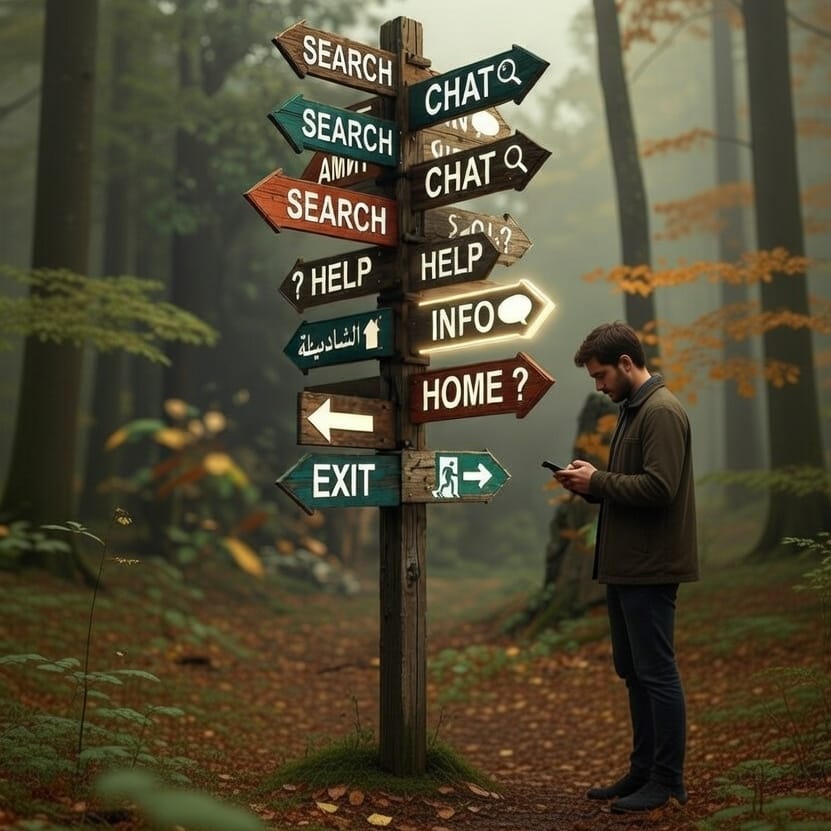
*The web was built for humans clicking links. The next web is being built for agents completing tasks. The question to consider: what is that UX like?*
TL;DR
- Search is dying. Conversation UX is eating it. But the infrastructure for what comes next can't be Materialism with a fancy prompt interface. We're in the age of Relationalism.
- Is the problem AI hallucinations or is it inaccurate metadata? LLMs are hallucinating because there isn't a "Web of Trust" for agents in the same way that SEO taught us to trust the 1st page (and even 1st result).
- Companies like OpenAI will probably get this wrong. Building a walled garden in the age of Open Source isn't the opportunity. The opportunity is collaboration.
We've Been Here Before
I'm old enough to remember the first crossing.
In 1994, I remember getting my first email address. It was with a company called Interlog (in Toronto) and while I can't remember the address; I remember explaining to my parents that it was like having a fax machine inside the computer.
The internet was within platforms, and those platforms were curated.CompuServe had *channels*, curated content, a directory of services. vRave had actions like sending *Pixie Sticks* to people. It was fun, personal, it felt complete. It felt like "the internet."
Then someone showed me Netscape Mosaic (Jamie Arlan to be exact)..!!!
I wanted nothing less!!! Suddenly I could type any URL and go anywhere. No directory. No curation. No walled garden. No telnet to green screen servers in terminal prompts. Just... the open web.
It was terrifying and exhilarating. Most of it was garbage and every couple of weeks a bunch of us were trading URLs and IP addresses to stuff we were finding. But it was *open* garbage, and that made all the difference.
These closed CompuServe like platforms didn't survive the crossing. Neither did AOL, not really—they all became content zombies, then punchlines. The walled gardens lost to the open protocols.
The Walled Garden Graveyard
Highlights of this age of the internet for me was around a handful of service providers.
CompuServe thought they owned discovery. They had forums, databases, news. Why would anyone leave? But the web didn't need their permission to exist.
AOL tried even harder. Keywords. Curated channels. That voice saying "You've got mail!" They spent billions convincing people that AOL *was* the internet. For a while, it worked. Then people discovered browsers.
Apple's FirstClass was actually exciting. It was a client-server BBS system with a beautiful GUI. Much better than my Commodore 64 adventures from back-in-the-day. Schools and organizations loved it. I loved it too and dreamed of being an admin to a system. But it was proprietary.
The pattern is always the same:
- A walled garden provides convenience and curation
- An open protocol emerges that's messier but permission-less
- The garden dies; the protocol wins
When PHP forums (vBulletin, phpBB) and open-source BBS platforms emerged; every closed platform became a footnote. HTTP beat AOL keywords. SMTP beat CompuServe mail. The weird, chaotic, PHP-powered forum culture of the 2000s beat every proprietary community platform.
The Second Crossing
Now, we're in another drift right now. If my muscle memory is shifting, then maybe I'm not the only one. If you are going straight to a chat window, using voice to ask questions, then maybe you're not the only one either.
In 2024, I still Googled things, and considered that Page 1 experience the ONLY context I needed in understanding the facts. Occasionally asked ChatGPT for quick answers and context; but the limits were obvious and the LLMs were so wrong, it was easy to see their gaps.
In 2025, I started asking Claude and co-writing articles with various LLMs here on Humanjava. With notes at the end of each article outlining who and what their engagement was.
January 2026... I'll type a search term in the URL, and catch myself mid-search wondering why bother. Here's me; closing the browser tab, and opening a chat window instead.
The quiet part out loud
Nobody's talking about it, but the handshake is broken.
Forget students writing term papers with AI. I took a picture of my oven temperature display, and asked Claude to help me diagnose the problem. And ended up ordering and installing a new temp sensor from Amazon. Problem solved, cookies are baking at accurate temps again.
I remember when I stopped searching Google and started searching Youtube. When my goal was not an article, but context to my situation. Maybe you do the same... maybe you don't. But if there's a new product, or a place you want to visit, consider reaching for Video over text.
Why? When I searched Google, the results were crawled, indexed, ranked. Messy, game-able, but structured. There was a protocol; a time when websites featured their relevance. Descriptions and keywords: "here I am, here's what I'm about, here's how to find me".
Now it's easier to see a thumbnail, compare the channels, the view counts; with video, it's contextual. Its personal. The results will be accurate to my level of understanding and more likely to be useful. And now LLMs have taken ANY context away without providing relevance in anything more that a small "Sources link" button that's easily ignorable.
The pivot for LLMs
When I ask an LLM "who's the best plumber in ______ ?", it's pulling from training data that's 6 months to 2 years stale, mixed with hallucinated confidence. The plumber it recommends might be out of business. The phone number might be wrong. The "5-star rating" might be invented. All based on search, which is also gamed into a cesspool of garbage. Review sites, might be better, but LLMs are not nearly useful enough for that either.
At this point, we've returned to door-to-door knockers and doorknob hang tags to break through the sales funnel for those with a top-of-mind need. And situationally, even if we had transcripts of situational video, the LLMs might be able to provide better context; but scraping data is so 2025! We've crossed from search to conversation, but we forgot to bring the map.
The Metadata Gap
Here's the uncomfortable truth: LLMs don't know what we want to actually do.
They know what was on any visited website the last time a crawler scraped it. The LLM models have been refined to know what the SEO terms have been optimized for. They know what showed up in some Reddit thread from 2023. But they don't know:
- From the people typing the prompts:
- What is relevant to my situation?
- How can I be sure what the LLM knows meets my empathetic needs?
- From the LLM models dispatching information
- Which part of information across multiple sources is most relevant?
- What if the data was scraped without consent and is already stale?
In the search era, we built an entire industry around "Search Engine Optimization". Trillions of dollars moved based on who showed up on page one. Now we're entering the "Answer Engine" era, and there's no equivalent infrastructure. This isn't an AI problem. This is a metadata problem.
No `robots.txt` for LLMs. No structured handshake. No way for a business to say: "Hey agent, here's the truth about me—verified, timestamped, current, and not stolen from somewhere else."
Why the Walled Garden Will Lose (Again)
We're starting to see the same patterns emerging again. OpenAI with ads, Google injecting sometimes relevant videos, and everyone else trying to figure it out. The enshittification is right on schedule. First they make it useful, then they make it profitable, then they make it unusable for everyone except advertisers.
This is AOL keywords all over again.
"Want to be found? Register your AOL keyword!"
"Want to be found? Build a ChatGPT plugin!"
Same energy. Same mistake.
- It creates another gatekeeper. If I'm a business, I now have to optimize for Google AND integrate with platforms like OpenAI, Claude, and Perplexity. We're not solving the fragmentation problem; we're multiplying it.
- It centralizes trust in the wrong place. Across the public internet, people have become fans of various models. Updates to those experiences break peoples hearts, and in some cases (without warning) their production apps?
- The AI conversation business model. LLMs that want to be the notary for the commercial web, AND the language of users and their relationships. Without clear UX around what the LLMs understand. It's the challenge of trust and verification.
The Open Web Won Before
The AI era needs its own open handshake. Not a plugin marketplace. A protocol. Remember what beat the walled gardens:
- Email: SMTP was ugly and spam-ridden, but it was open. Anyone could run a mail server.
- Web: HTTP was chaotic, but you didn't need permission to publish.
- Forums: vBulletin and phpBB were janky PHP scripts, but any teenager could spin one up on shared hosting.
- Blogs: WordPress democratized publishing. Movable Type, Blogger, then the explosion of self-hosted voices.
The pattern: Permission-less beats curated. Every time. That protocol will win. The walled garden will become another punchline. We solved this problem before. We can solve it again.
The Crossing Is Happening
I don't have all the answers yet. But I know the shape of what's coming, but a lot of it is around being present and participating. The companies that understand this transition will build for the open web, not the walled garden.
The ones that don't will find themselves paying rent to platforms like OpenAI forever. Just like businesses paid rent to AOL in 1998, right before the garden collapsed.
The question isn't whether the walled gardens will try to own chat. Of course they will. The question is whether we build the open alternative fast enough. The drift from search to conversation is happening whether we're ready or not.
We've done it before. We can do it again. The protocol beats the platform. Every time.
Note: This article was written by Vergel in collaboration with Gemini and Claude via Windsurf Cascade. Where I (Vergel) brought the heat and conversation, and the LLMs provided the context and continued conversation. Kimi, Qwen and ChatGPT thought the idea was relevant and resonated with the challenge.